AEO meaning: what answer engine optimization is
Answer engine optimization is the work of making a brand show up, accurately and favorably, in the answers AI assistants write. An answer engine is any system that replies to a question with written text instead of a list of links: ChatGPT, Google AI Overviews and AI Mode, Gemini, Perplexity, Claude and Microsoft Copilot.
AEO has three outcomes. Keep them apart, because they move separately:
- Mentioned: the answer names your brand at all.
- Recommended: the answer suggests your brand for what was asked.
- Cited: the answer links to one of your pages as a source.
The unit is what sets AEO apart from classic search. A results page is a ranked list that holds still. An AI answer is written fresh each time, and the next run of the same question often names different brands. So AEO is about raising the share of answers you appear in, not holding position one.
How answer engines build an answer: trained knowledge vs live search
Answer engines answer from two places: what the model learned in training, and what it finds by searching the web while it answers. Only the second can produce a citation, and the two need different work.
Trained knowledge is what a model absorbed from its training text, and it grows with frequency: question-answering accuracy rises with the number of training documents that mention an entity (Kandpal et al., ICML 2023). It is frozen at each model release, so a brand launched after the training cutoff can't come up from memory, and mentions earned today only reach later models.
Live search is the other path, and it dominates buying questions. Only about 14% of 66.6 million logged-out ChatGPT responses ran a web search (Ahrefs, Oct 2026), but a smaller study found search on more than 80% of commercial prompts (cloro). The guide to known vs found shows how to test which path is failing for a brand.
How AI search works: fan-out queries, snippets and the 20-to-3 citation funnel
When an answer engine searches, it rewrites the question, reads short snippets and cites a few results. The steps are best measured on ChatGPT; the other engines follow the same broad pattern.
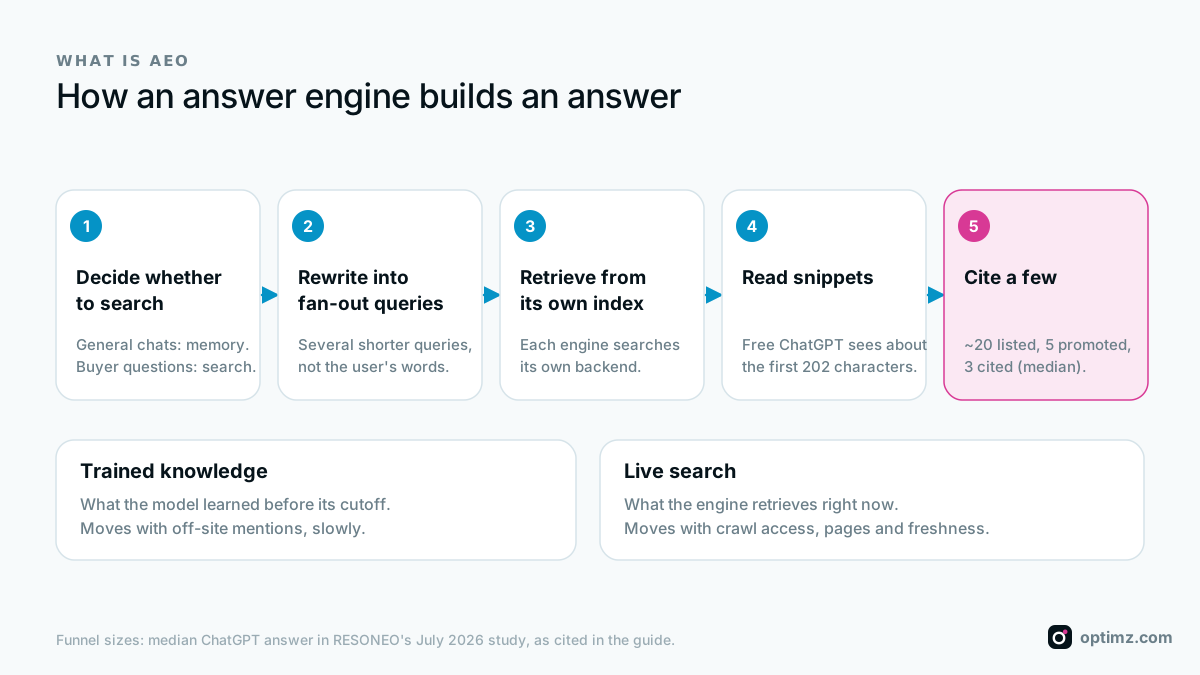
- The engine decides whether to search. Most general chats are answered from memory; most buying questions trigger a search.
- It rewrites the question into fan-out queries. An academic comparison found GPT-5.3 and GPT-5.5 Instant never searched with the user's exact wording (arXiv 2610.15382, Oct 2026). In RESONEO's July 2026 data, free ChatGPT usually ran one query per answer and paid thinking modes a median of six.
- It retrieves results from its own index, which differs by engine (see the table below).
- It reads snippets, not pages. Free ChatGPT mostly sees the first ~202 characters of each page's body text, stored at crawl time. It opened only about 1.2% of the pages it retrieved (RESONEO).
- It cites a few. The median ChatGPT answer listed about 20 pages, promoted 5 and cited 3 (RESONEO, Jul 2026).
Google and Microsoft describe the same step. Google says AI Overviews and AI Mode may use “query fan-out”, “issuing multiple related searches across subtopics and data sources”. Microsoft's Copilot Chat documentation shows a question about a company's strategy and finances becoming the Bing searches “Fabrikam strategy” and “Fabrikam financials”.
Which search index ChatGPT, Google AI, Perplexity, Claude and Copilot use
Each answer engine searches a different index, so ranking in Google covers only part of AEO. The table shows where each one searches and which bot or rule controls access. Engines change often, so treat it as a dated snapshot.
| Answer engine | Where it searches | Access gate |
|---|---|---|
| ChatGPT | OpenAI's own index, scraped Google results, Bing and partner feeds. Free answers drew 63.6% of results from OpenAI's index, paid thinking 74.6% from Google (RESONEO, Jul 2026) | OAI-SearchBot builds the index; ChatGPT-User fetches pages on request |
| Google AI Overviews and AI Mode | Google's search index | Indexed in Google and eligible to show a snippet |
| Gemini app | Grounding from Google Search | The Google-Extended robots.txt token |
| Perplexity | Its own index of more than 200 billion URLs | PerplexityBot |
| Claude | Brave Search, plus other web search providers on Anthropic's subprocessor list | Claude-SearchBot crawls for search; Claude-User fetches pages on request |
| Microsoft Copilot | Bing's index | Bingbot; a noarchive tag keeps a page out of answers |
One detail catches people out: blocking GPTBot, OpenAI's training crawler, does not remove a site from ChatGPT search, per OpenAI's documentation. The AI crawler user-agent list covers every bot and what blocking it does.
AEO strategy: the work, in order of evidence
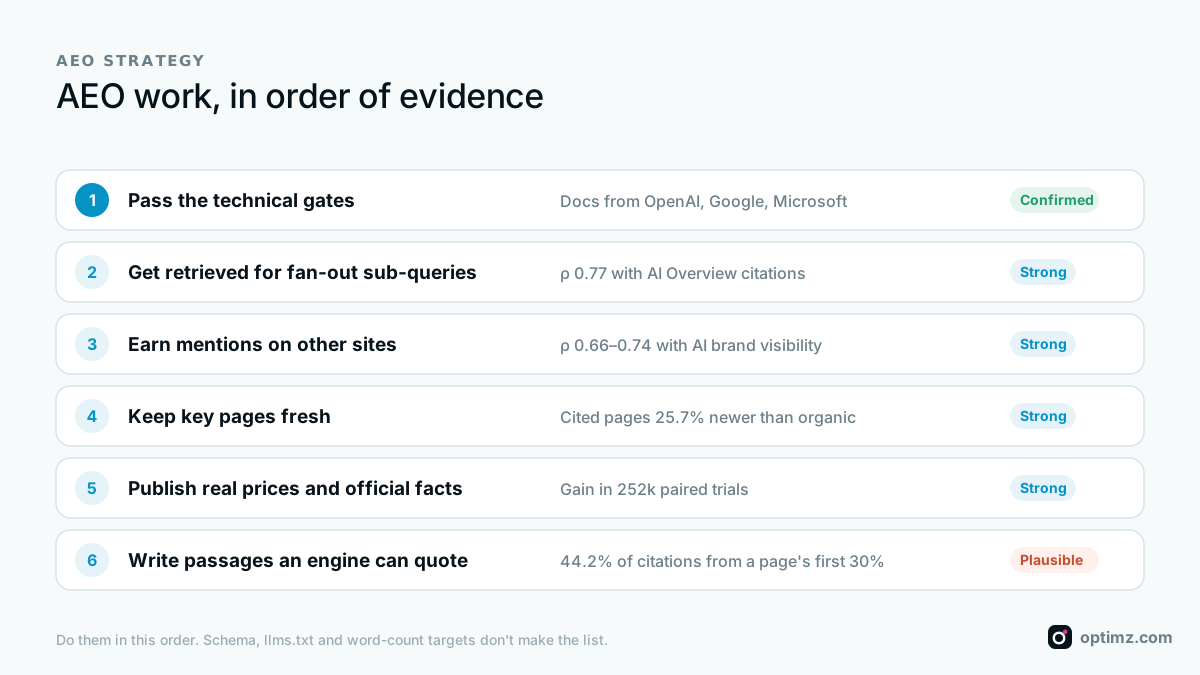
The table ranks the six kinds of AEO work, strongest evidence first. Start with what lets engines read your pages, then what gets you retrieved, then what tips the choice.
| Order | AEO work | Best evidence | Grade |
|---|---|---|---|
| 1 | Pass the technical gates | Docs from OpenAI, Google and Microsoft | Confirmed |
| 2 | Get retrieved for fan-out sub-queries | Spearman 0.77 with AI Overview citations (Surfer); +2.77 positions in a lab test (C-SEO Bench) | Strong |
| 3 | Earn mentions on other sites | Spearman 0.66–0.74 with AI brand visibility (Ahrefs, 75k brands) | Strong, as a correlation |
| 4 | Keep key pages fresh | Cited pages 25.7% newer than organic results (Ahrefs, 17M URLs) | Strong, except AI Overviews |
| 5 | Publish real prices and official facts | Consistent gain in 252k paired trials (What Gets Cited, 2026) | Strong |
| 6 | Write passages an engine can quote | 44.2% of ChatGPT citations from a page's first 30% (Growth Memo) | Plausible |
1. Pass the technical gates
A page that fails a gate can't be cited, however good it is. These four checks come first:
- Bot access. robots.txt and firewall rules must let search and AI retrieval bots through; a firewall challenge blocks a bot as surely as robots.txt.
- Content in the server HTML. AI fetchers don't run JavaScript, so text rendered only in the browser is invisible to them.
- Google indexing and snippets. Google says a page must be indexed and eligible to show a snippet to be a supporting link in AI Overviews or AI Mode.
- Bing noarchive. Microsoft says pages tagged noarchive are left out of Bing Chat answers, the product now called Copilot.
The Optimz site audit checks crawler access, server-rendered content, an answer at the top of the page, and indexing in Google and Bing.
2. Get retrieved for the fan-out sub-queries
The strongest lever a site controls is being retrieved for the searches engines actually run. Surfer found a Spearman correlation of 0.77 between the number of fan-out queries a page ranks for and its AI Overview citations (10,000 keywords; correlational, using fan-outs generated by Gemini). Ranking for the head term predicts much less: about 8% of ChatGPT's citations overlapped Google's top 10 for the user's question (Ahrefs, 15,000 prompts, Jul 2025).
In practice, collect the fan-out queries engines run for your buyer questions, and make sure a page answers each recurring one plainly. Watch for modifiers such as the year, “price” and “official”, which Ahrefs found becoming more common in ChatGPT's rewrites. Optimz's fan-out queries view keeps the web searches each engine ran while answering.
3. Earn mentions on other sites
AI answers lean on what other sites say about you. Across 75,000 brands, branded web mentions correlated with AI visibility at Spearman 0.66–0.71 and YouTube mentions at about 0.74 (Ahrefs). Brand size confounds that correlation, but it fits the mechanism: mentions feed both training data and the pages engines retrieve.
Aim for honest coverage in the reviews, comparisons, forums and videos engines already cite for your questions. Self-published “best X” lists are weaker: in Ahrefs' experiment on its own brands, they helped a little-known brand get mentioned, barely moved an established one, and faded.
4. Keep key pages fresh
Most answer engines prefer recent pages. AI assistants cited pages 25.7% newer than Google's organic results (Ahrefs, 17 million URLs), and in a lab test a recent date alone moved a passage up by as many as 95 ranks (Fang et al., SIGIR-AP 2025). AI Overviews are the exception, citing slightly older pages than organic results. Update pages when their facts change, with a matching date; changing only the date is a spam risk.
5. Publish real prices and official facts
If buyers ask what something costs, say it in the page text. In 252,000 controlled paired trials across six models, explicit price information was a consistent gain (What Gets Cited, arXiv 2026).
Engines also go straight to brand sites for official facts: 6.8% of ChatGPT's fan-out queries used the site: operator, and 76% of those targeted brand websites (Ahrefs, Oct 2026). Put plans, specifications and policies on your own pages as text, not only in PDFs or images.
6. Write passages an engine can quote
Once retrieved, a page is usually read in slices: free ChatGPT mostly sees the opening ~202 characters (RESONEO), and Perplexity splits pages into self-contained spans that it ranks one by one, per its own engineering write-up. So put the H1 first, follow it with a sentence that answers the question, and make each section stand on its own.
The evidence here is weaker than it sounds. 44.2% of ChatGPT citations came from the first 30% of a page (Growth Memo, 18,012 citations), but there is no base rate for where answers usually sit. Write answer-first because it helps readers, not because it is a proven lever. The free ChatGPT snippet preview shows what a page's opening holds.
What doesn't work in AEO: schema, llms.txt, word count and added statistics
Several popular AEO tactics have been tested and do nothing measurable for AI citations; some do harm.
- Schema markup. Ahrefs compared 1,885 pages that added JSON-LD with about 4,000 matched pages (May 2026): ChatGPT +2.2% and AI Mode +2.4%, both not significant, and AI Overviews −4.6%. None of the JSON-LD in searchVIU's fetch tests reached ChatGPT, Claude or Perplexity. Keep schema for Google rich results.
- FAQ schema. In SE Ranking's study of 216,524 pages, pages with FAQ schema averaged 3.6 citations and pages without it 4.2 (Nov 2025).
- llms.txt. Ahrefs found that 97% of llms.txt files across 137,000 sites received no requests in May 2026. Google says you don't need AI text files to appear in its AI features.
- Word count. Ahrefs found a correlation of 0.04 between word count and AI Overview citations across 174,000 pages, close to no relationship at all.
- Added statistics and quotations. The 2024 GEO paper reported gains of up to about 40% in its benchmark. A July 2026 re-run on 10 modern engine families found effects indistinguishable from zero or negative (a vendor-affiliated preprint), and C-SEO Bench found many such edits significantly negative, including 26 of 30 cases on one model.
- Keyword stuffing. Negative in the original GEO tests (−8.8) and still null to negative in 2026.
Across the controlled work, generic page edits don't carry over to modern engines; getting retrieved is the bottleneck. The graded table is in what moves AI citations.
How to measure AEO: mention rate, sample size and confidence ranges
Measure AEO as a rate over many answers, never as one answer or a rank. Two runs of the same question share only about 40–60% of the brands named and 25–50% of the sources cited, across several independent studies, so a single screenshot tells you very little.
SparkToro and Gumshoe ran 12 prompts 2,961 times across ChatGPT, Claude and Google's AI features (Jan 2026): the same brand list came back less than 1% of the time, yet how often each brand appeared was fairly stable. So the unit to report is mention rate: the share of sampled answers that name you, pooled over questions, runs and weeks.
Sample size decides how much a rate can tell you. At a rate near 50%, about 100 answers gives a 95% range of ±10 points and about 400 gives ±5 points (standard binomial math, set out for AI tracking by Peec AI, Sep 2026). The table shows 95% Wilson ranges we computed for two observed rates.
| Answers sampled | Observed rate 50% | Observed rate 20% |
|---|---|---|
| 10 | 24–76% | 6–51% |
| 30 | 33–67% | 10–37% |
| 100 | 40–60% | 13–29% |
| 400 | 45–55% | 16–24% |
Three more habits keep AEO numbers honest:
- Track each buyer question as a few paraphrases. Rewording a question changed the recommended brands more than rerunning it did (arXiv 2605.27440, May 2026).
- Label the surface. The ChatGPT API's full source list covered only about 23% of the pages the ChatGPT app cited (arXiv 2610.15382, Oct 2026), so API data and app data are different measurements.
- Compare against a control group. In Ahrefs' schema study, the raw before-and-after on AI Mode was +43%. Against matched pages that changed nothing, the net effect was about +2% and not significant.
Optimz's AI visibility tracking asks AI engines your buyer questions every week and reports how often you are mentioned, recommended and cited, with a 95% range. The full method is in how to measure AI visibility without fooling yourself.
AEO vs SEO: how answer engine optimization relates to search
AEO builds on SEO rather than replacing it, because most answer engines search an index before they write. Google says there are no additional requirements to appear in AI Overviews or AI Mode, and no special schema or AI text files to add.
What changes is the target and the scorecard:
- The query. SEO competes for what a person types. AEO also competes for the rewritten sub-queries an engine runs, which are usually more specific.
- The index. SEO usually means Google. AEO also means Bing for Copilot, OpenAI's index for ChatGPT, Perplexity's own index and Brave for Claude.
- The outcome. SEO measures rank and clicks. AEO measures how often answers mention, recommend and cite you, as rates with ranges.
- Off-site work. In AEO, mentions elsewhere also shape what a model knows before it searches.
GEO, short for generative engine optimization, is another name for the same work, taken from a 2023 research paper later published at KDD 2024 (see the GEO glossary entry). For how the metrics differ in reporting, read SEO and AI visibility: what agencies should measure.
Where to start with AEO this week: a checklist
Start with the checks that can rule a page out entirely, then measure before you change any content.
- Run key pages through the free AI crawler checker. Search and user bots such as OAI-SearchBot, PerplexityBot and Claude-SearchBot should get in, with no firewall challenge.
- Confirm the main content is in the server HTML, and that key pages are indexed in Google and Bing without stray nosnippet or noarchive tags.
- Write 10–30 questions your buyers really ask, with a few wordings each, and freeze the list.
- Collect answers from each engine for two to four weeks before changing anything, as a baseline.
- Note the fan-out queries engines run for those questions, and list the ones no page of yours answers.
- Fix the opening of your most important pages: the H1 first, then one sentence that answers the question.
- Put real prices and official facts in the page text, and update stale pages in substance with a matching date.
- List the third-party sites cited for your questions where competitors appear and you don't: that is your off-site plan.
- Take schema, llms.txt and word-count targets off your AEO plan.
Sources
- Google Search Central, AI features and your website
- Google Search Central, Google's common crawlers (Google-Extended)
- OpenAI, Overview of OpenAI crawlers
- Microsoft Learn, Copilot Chat privacy and protections (generated Bing queries)
- Bing Webmaster Blog, NOCACHE and NOARCHIVE for Bing Chat answers (Sep 2023)
- Perplexity, Architecting and evaluating an AI-first search API (Sep 2025)
- Perplexity, Perplexity crawlers
- Anthropic, How Anthropic crawls the web and how site owners can block it
- Simon Willison, Anthropic lists Brave Search as a subprocessor (Mar 2025)
- Xponent21, Claude's web search providers: Brave and turbopuffer (Jul 2026)
- Kandpal et al., LLMs struggle to learn long-tail knowledge (ICML 2023)
- Aggarwal et al., GEO: Generative Engine Optimization (KDD 2024)
- Puerto et al., C-SEO Bench (NeurIPS 2025)
- GEO re-run and content-score validation (arXiv, Sep 2026)
- What Gets Cited: paired trials across six LLMs (arXiv 2026)
- Fang et al., recency bias in LLM reranking (SIGIR-AP 2025)
- ChatGPT web app vs API citations (arXiv 2610.15382, Oct 2026)
- Paraphrase and rerun stability of AI brand recommendations (arXiv, May 2026)
- Schulte, Bleeker and Kaufmann, Don't Measure Once (arXiv, Apr 2026)
- RESONEO, How ChatGPT retrieves and cites sources (Jul 2026)
- Ahrefs, Query fan-out in ChatGPT (Oct 2026)
- cloro, How often ChatGPT grounds answers in search
- Ahrefs, AI search citation overlap with Google and Bing
- Surfer, query fan-out and AI Overview citations
- Ahrefs, AI brand visibility correlations (75k brands)
- Ahrefs, self-promotional content and AI visibility: an experiment
- Ahrefs, Do AI assistants prefer to cite fresh content?
- Growth Memo, Where on the page ChatGPT citations come from
- Ahrefs, Schema markup and AI citations: a difference-in-differences test (May 2026)
- searchVIU, What ChatGPT, Claude, Perplexity and Gemini see of schema markup
- Search Engine Journal, SE Ranking data on factors behind ChatGPT citations (Nov 2025)
- Ahrefs, llms.txt study
- Ahrefs, short vs long content in AI Overviews
- SparkToro, AIs are highly inconsistent when recommending brands (Jan 2026)
- Peec AI, the key to prompt tracking: sample sizes (Sep 2026)