How AI citation works in 2026: retrieval first, content second
AI citations are decided mostly by whether a page is retrieved for the engine's searches, and only then by what the page says. The controlled research agrees on this pattern. Once a document is in the model's context, its content can change how it gets cited. But the generic content edits that worked in lab studies don't transfer to modern engines, and getting retrieved is the bottleneck.
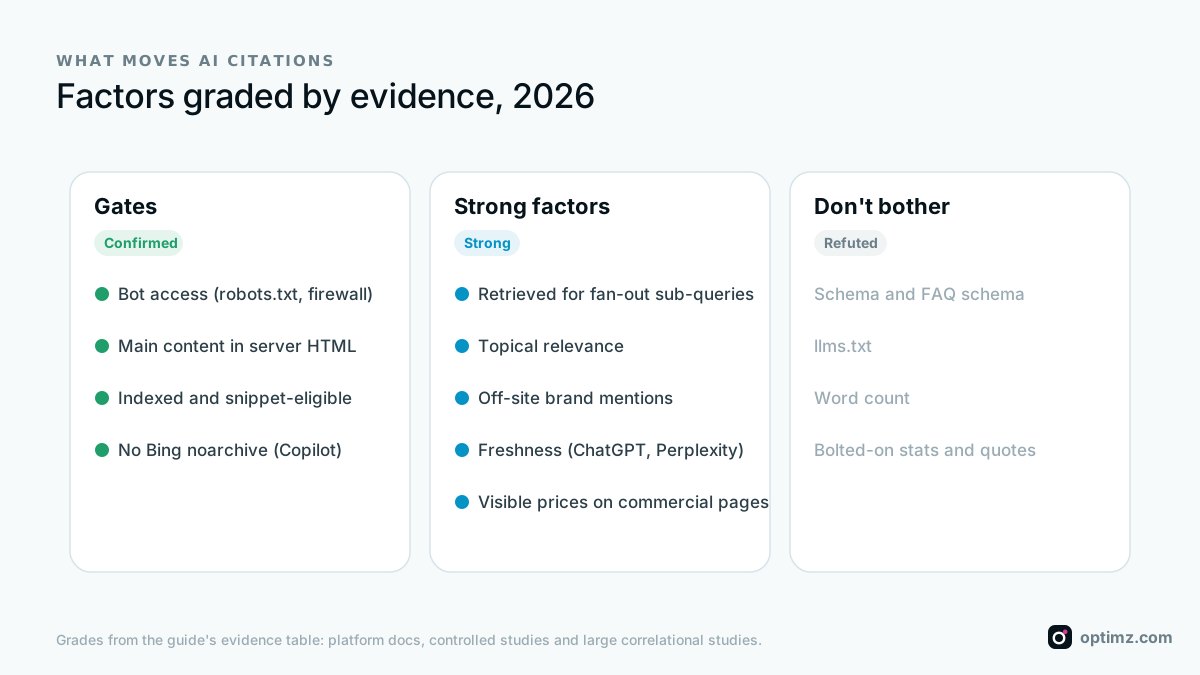
That gives a simple order of work. First pass the gates that let a page be fetched and used at all. Then win retrieval for the sub-queries engines actually run. Then make the page easy to quote. Much popular advice skips the first two steps and spends its effort on markup the engines never read.
Measurement noise sits under all of it. The same prompt at the same moment shares only 32–43% of cited sources between runs (Don't Measure Once, arXiv, data from Jan–Mar 2026), and about 15% of cite or don't-cite decisions flip when the model is simply rerun (CITECHOICE, arXiv 2026). Any claim about a factor needs many runs and a comparison group.
Gates: the technical checks that decide whether a page can be cited at all
A page that fails a technical gate cannot be cited however good it is. The four gates below are confirmed by platform documentation or repeated fetch tests.
- Bot access. robots.txt and firewall rules must let search and AI retrieval bots through, such as OAI-SearchBot, ChatGPT-User, PerplexityBot and Claude's search bot. A firewall challenge page blocks them just as robots.txt does. The AI crawler user-agent list names each one.
- Main content in server HTML. AI fetchers don't run JavaScript. If the text appears only after client-side rendering, the bot sees an empty shell (confirmed by crawler data from a hosting platform and by repeated fetch tests).
- Google indexing and snippet eligibility. AI Overviews and AI Mode use only indexed, snippet-eligible pages. nosnippet, max-snippet:0 and data-nosnippet remove text from them (Google's AI optimization guide).
- Bing noarchive. Microsoft documents that noarchive keeps a page out of Copilot answers, while nocache still lets it appear with only its URL, title and snippet.
The Optimz site audit checks these gates, including whether Bing has indexed the page and how ChatGPT's snippet starts, and grades each check by the strength of its evidence.
Strong factors: retrieval for fan-out sub-queries and topical relevance
Being retrieved for the engine's fan-out sub-queries is the strongest factor a site can influence, and those sub-queries are not the user's prompt. Ranking in the top 10 for the head term is neither necessary nor sufficient.
Overlap between AI citations and Google's top 10 for the parent query is low, and the studies disagree. ChatGPT is about 8–12% (Ahrefs, 15k prompts, Jul 2025). AI Overviews range from 17% (BrightEdge, Feb 2025–Feb 2026) to 38% (Ahrefs, 863k SERPs, Mar 2026). 88% of AI Mode citations are not in the organic results for the exact query (Moz, 40k queries). Ranking for the sub-queries predicts better: Surfer found a Spearman correlation of 0.77 between the number of fan-out queries a page ranks for and its AI Overview citations (10k keywords, correlational, with Gemini-generated fan-outs standing in for Google's).
In a lab benchmark, moving a document to the top of the model's context raised its citation rank by 2.77 positions on average (C-SEO Bench, NeurIPS 2025). That is strong evidence that retrieval exposure matters. That a higher organic rank alone adds citations is only plausible.
Topical relevance is the largest single driver in the cleanest controlled ranking of on-page levers (What Gets Cited, 252k paired trials across six models, arXiv 2026, abstract read). A page that answers the exact sub-question beats a page that covers the topic in general.
Strong factors beyond the page: off-site mentions, freshness and visible prices
Off-site brand mentions, freshness and visible prices are the other factors with strong evidence, and each comes with a limit.
- Off-site mentions. Branded web mentions correlate with AI brand visibility at Spearman 0.66–0.71, and YouTube mentions at about 0.74 (Ahrefs, 75k brands). That is a correlation, brand size confounds it, and the outcome is brand mentions rather than page citations. Strong as a correlation, plausible as a cause.
- Freshness, except in AI Overviews. Adding a recent date alone moved passages by up to 95 ranks in a lab reranking test (Fang et al., SIGIR-AP 2025). On live engines, AI assistants cite pages 25.7% newer than Google's organic results (Ahrefs, 17M URLs). AI Overviews are the exception: their citations are slightly older than organic results. Faking dates is a spam risk, so update the substance and the date together.
- Visible prices on commercial queries. Explicit price information was a consistent gain in the controlled What Gets Cited trials. If buyers ask about pricing, put real prices in the page text.
Small or plausible factors: answer-first, structure and entity density
Answer-first writing, clear structure and specific named facts probably help a page that is already retrieved, but the evidence is weaker and the effects are small.
- Answer early. 44.2% of ChatGPT citations came from the first 30% of a page's text (Kevin Indig with Gauge, 1.2M answers, 18k citations). There is no base rate for where answers usually sit, so this is plausible, not proven. It does fit a strong mechanical fact: free ChatGPT mostly sees a snippet of roughly the first 202 characters of a page's body.
- Structure. In a causal replay on real search transcripts, structured rendering gave +0.50 citations per answer but did not help a page get admitted to the answer in the first place (CITECHOICE, 103 document pairs). Formatting-only edits had little impact in the What Gets Cited trials.
- Entity density and definitions. Cited text had 20.6% entity density against a 5–8% baseline, and was about twice as likely to contain definitional language (Indig, 18k ChatGPT citations, descriptive).
Write an answer-first opening because it helps readers and fits the snippet window, not because it is a proven ranking lever.
Refuted: schema, FAQ schema, llms.txt and other levers that don't move AI citations
Controlled tests and replications found no effect on AI citations for the most common AEO advice. Some of these levers matter for other reasons, but not for being cited.
- JSON-LD schema. Ahrefs compared 1,885 pages that added schema with 4,000 matched controls (difference-in-differences, May 2026): ChatGPT +2.2% and AI Mode +2.4%, both not significant, and AI Overviews −4.6%. Fetch tests found ChatGPT, Claude and Perplexity strip JSON-LD scripts when they read a page. Keep schema for Google rich results.
- FAQ schema. Pages without FAQ schema got 4.2 citations against 3.6 with it (SE Ranking). A visible FAQ section is a different thing and may help.
- llms.txt. 97% of the files were never fetched (Ahrefs, 137k sites), and Google ignores the file.
- Word count. Ahrefs found ρ = 0.04 between word count and AI Overview citation (174k pages). Google says there is no ideal page length.
- Core Web Vitals beyond extremes. LCP correlated −0.12 to −0.18 with AI visibility, driven by outliers, and the link vanished after controlling for domain (Search Engine Land, 107k pages). Only extreme failures matter.
- Bolting on statistics and quotations. The 2024 GEO paper reported gains of +27.7 to +42.6. A re-run on 10 modern engine families in July 2026 found effects indistinguishable from zero or negative (a vendor-affiliated preprint), and C-SEO Bench found many methods significantly negative, including 26 of 30 cases on one model.
- Keyword stuffing. Negative in the GEO paper (−8.8) and still null to negative in 2026.
- Outbound links to authorities. Almost no measurable impact (SE Ranking), and “cite sources” edits were null in the 2026 re-run.
The evidence table: AI citation factors by grade (2026)
The table lists each AI citation factor with its best effect estimate, the evidence behind it and its grade. Confirmed means documented or replicated on live engines. Strong means a controlled result plus consistent large-sample data. Plausible means observational or lab-only. Refuted means a controlled test or replication found no effect.
| Factor | Effect (best estimate) | Evidence | Grade |
|---|---|---|---|
| Bot access (robots.txt, firewall) | Gate: blocked pages can't be fetched | Platform docs, crawler tests | Confirmed |
| Content in server HTML | Gate: bots don't run JavaScript | Crawler data, fetch tests | Confirmed |
| Google indexed and snippet-eligible | Gate for AI Overviews and AI Mode | Google AI optimization guide | Confirmed |
| Bing noarchive | Gate for Copilot (nocache limits it to URL, title and snippet) | Microsoft documentation | Confirmed |
| Retrieved for fan-out sub-queries | ρ 0.77 with AI Overview citations; +2.77 positions in lab | Surfer, 10k keywords; C-SEO Bench | Strong |
| Topical relevance | Largest driver in paired trials | What Gets Cited, 252k trials | Strong |
| Off-site brand mentions | ρ 0.66–0.74 with brand visibility | Ahrefs, 75k brands | Strong (correlation) |
| Freshness (not AI Overviews) | Up to 95 ranks in lab; cited pages 25.7% newer | Fang et al. 2025; Ahrefs, 17M URLs | Strong |
| Visible prices on commercial queries | Consistent gain | What Gets Cited, 252k trials | Strong |
| Answer early on the page | 44.2% of citations from the first 30% | Indig and Gauge, 18k citations | Plausible |
| Headings, lists and tables | +0.50 citations per answer, no admission gain | CITECHOICE, 103 pairs | Plausible |
| Entity density and definitions | 20.6% vs 5–8% baseline | Indig, 18k citations | Plausible |
| Referring domains | Weak correlation (0.27–0.33) | Ahrefs; SE Ranking | Plausible |
| JSON-LD schema | +2.2% and +2.4% (not significant); −4.6% on AI Overviews | Ahrefs DiD, 1,885 vs 4,000 pages | Refuted |
| FAQ schema | 4.2 citations without vs 3.6 with | SE Ranking | Refuted |
| llms.txt | 97% of files never fetched | Ahrefs, 137k sites | Refuted |
| Word count | ρ 0.04 | Ahrefs, 174k pages | Refuted |
| Core Web Vitals beyond extremes | Null after domain controls | Search Engine Land, 107k pages | Refuted |
| Added statistics and quotations | Zero or negative on modern engines | GEO re-run 2026; C-SEO Bench | Refuted |
| Keyword stuffing | −8.8; still null to negative | GEO paper; 2026 re-run | Refuted |
| Outbound links to authorities | Almost no impact | SE Ranking; 2026 re-run | Refuted |
Why most vendor AI citation studies mislead
Most vendor studies of AI citation factors mislead because they look only at cited pages and have no control group. Three flaws come up again and again.
- Survivorship. A study that collects only cited pages can't say what uncited pages looked like. If cited pages are fresh, that may be because the whole category is fresh. Several recency studies have this flaw, and one of them says so itself.
- No controls. A before/after number mixes your change with platform-wide shifts. In Ahrefs' schema study, the raw before/after on AI Mode was +43%. Against matched controls, the net effect was about +2% and not significant. The rest was AI Mode citing more pages overall.
- Confounding by size. Big sites are fast, fresh, long and well linked at the same time, so correlations with speed, length or schema mostly measure site quality.
Studies of position have a related problem. In CITECHOICE, raw rank correlations overstated the causal effect of position by about 5x: ranks 1 and 5 differed by 42.3 points in observational data, but actually swapping them moved citations by 7.9 points, and by zero on held-out data. A 2026 survey of 45 studies found no technique with a stable, long-run, cross-platform causal effect on discoverability (Martinez, arXiv 2026). When Optimz measures a fix, it compares the result against control groups for the same reason.
What to fix first: an AI citation checklist for agencies
Agencies should fix AI citation problems in evidence order: gates first, then retrieval, then the page, then off-site work.
- Check bot access for every search and AI retrieval bot, including firewall challenges.
- Confirm the main content is in the server HTML.
- Confirm indexing and snippet eligibility in Google and Bing, and remove stray nosnippet or noarchive tags.
- Collect the fan-out searches engines run for your buyer questions, and build or improve pages that answer those sub-queries.
- Put the direct answer in the first 200 characters of the body, starting at the H1.
- Show real prices on commercial pages, and keep key pages updated in substance, with a visible date.
- Plan off-site work: earned mentions, reviews and comparisons in the sources your target engines cite.
- Drop schema, llms.txt, word-count targets and bolted-on statistics as AI citation tactics.
- Measure every change against a control group over several weeks, as set out in how to measure AI visibility without fooling yourself.
Sources
- Ahrefs, schema markup and AI citations: a difference-in-differences test (May 2026)
- Bing Webmaster Blog, NOCACHE and NOARCHIVE for Bing Chat answers (Sep 2023)
- Google Search Central, AI optimization guide
- Puerto et al., C-SEO Bench (NeurIPS 2025)
- GEO re-run and content-score validation (arXiv, Sep 2026)
- What Gets Cited: paired trials across six LLMs (arXiv 2026)
- CITECHOICE: causal replay of citation decisions (arXiv 2026)
- Fang et al., recency bias in LLM reranking (SIGIR-AP 2025)
- Ahrefs, AI brand visibility correlations (75k brands)
- Ahrefs, do AI assistants prefer to cite fresh content?
- Surfer, query fan-out and AI Overview citations
- Search Engine Land, Core Web Vitals and AI search visibility (107k pages)
- Ahrefs, short vs long content in AI Overviews