ChatGPT does not read the web the way a person does. For most answers it sees a short snippet of each page, taken from an index built days or weeks earlier, and it cites a few of the pages it pulled. The figures below come from OpenAI's documentation and from vendor studies. Each one names its sample, its date and how strong the evidence is. Engines change monthly, so treat every number as a dated snapshot.
How often ChatGPT searches the web before answering
ChatGPT searches the web for a minority of all conversations but for most buying questions. Profound's analysis of 700,000 conversations and Ahrefs' data on 66.6 million logged-out responses (Oct 2026) both put search at roughly 14–18% of answers overall. A smaller study by cloro found search on more than 80% of commercial prompts. The evidence is plausible rather than settled: several vendors, large samples, different definitions.
When ChatGPT does not search, it answers from parametric knowledge, meaning what the model learned in training. That knowledge freezes at each model release, so a brand launched after the cutoff cannot appear unless the model searches. Citations come only from the search path, which is the subject of this guide. The difference between being known and being found is covered in the guide to why a brand is missing from ChatGPT.
Which search backends ChatGPT uses in 2026
ChatGPT search draws on a mix of backends: OpenAI's own index, scraped Google results, Bing and licensed partner feeds. OpenAI's help pages say search uses “third-party search providers, as well as content provided directly by our partners,” and name Bing for Enterprise and Edu accounts. At the Google antitrust trial (Apr 2025), OpenAI's Nick Turley testified that ChatGPT uses Bing data and that Google had refused access to its index.
RESONEO measured the split in July 2026 (1,249 answers, 88,000 results), while ChatGPT's response data still labelled each result with its provider. That is a strong measurement, but OpenAI removed the label on July 21, 2026, so today's split is unknown.
| ChatGPT mode | OpenAI's own index | Scraped Google results | Other search vendors |
|---|---|---|---|
| Free, instant | 63.6% | 34.7% | 1.6% |
| Paid, thinking | 23.6% | 74.6% | 1.9% |
The practical reading is an inference from that data. On free ChatGPT, which most people use, being in OpenAI's own index matters more than Bing rank. On paid thinking modes, Google rank matters more. In free instant mode, OpenAI's index supplied nearly all results for stable facts, local businesses and products, while news results were about half Google.
OpenAI's own index is written by a crawler called OAI-SearchBot. OpenAI's crawler documentation lists three separate crawlers, and confirms that blocking the training crawler does not remove a site from ChatGPT search:
- GPTBot collects training data.
- OAI-SearchBot builds the search index ChatGPT retrieves from.
- ChatGPT-User fetches a page when a user's request needs it, and OpenAI says robots.txt “may not apply” to it.
Free vs paid ChatGPT: how many searches one answer runs
Free ChatGPT usually runs one search per answer, while paid thinking modes run several. RESONEO (Jul 2026) found a median of 1 query in free instant mode, with a single query in more than 80% of answers. Paid thinking had a median of 6, reaching 20–40 on some prompts. After a late-July change, medium-effort thinking dropped to about 1.9 queries. These are strong measurements of a moving target.
ChatGPT's searches are rewrites of the user's question, often called fan-out queries, not the question itself. An academic comparison of the ChatGPT app and API (arXiv 2610.15382, 2026) found that GPT-5.3 and GPT-5.5 Instant never searched with the user's exact wording. Ahrefs' study of 66.6 million free, logged-out responses (Oct 2026) found:
- 14.4% of responses contained fan-out searches, about 1.6 per response.
- 6.8% of fan-out queries used the “site:” operator, and 76% of those targeted brand sites.
- Words like “official”, “2026” and “price” were becoming more common in the rewrites.
A page therefore competes for the rewritten query, which is often longer and more specific than what the user typed. Optimz's fan-out queries view lists the searches each engine ran for a tracked question. The ChatGPT app has hidden most of its queries since GPT-5.3, so API runs are the main window into them.
The ~202-character snippet: why the H1 and first sentence matter
For most free ChatGPT retrievals, the only part of a page the model sees is the first ~202 characters of its rendered body text. RESONEO's fingerprinted test pages (2026) showed that OpenAI's index stores that opening as the snippet. It is not the meta description, and it does not change with the query. 83.6% of snippets contained the page's H1 and 77% started with it. Results from scraped Google carry Google's own snippet of about 159 characters instead. The grade is strong: one well-designed study on a large sample.
ChatGPT rarely opens the page itself. RESONEO found it opened about 1.2% of retrieved URLs, almost all in paid thinking mode. That makes the snippet window the page's whole pitch for most answers. Anything placed before the H1 eats the budget:
- Kickers and category labels above the headline.
- Publication dates and reading-time lines.
- Alt text from a hero image.
- Breadcrumbs and site names.
The snippet is also frozen at crawl time. In RESONEO's data, 13% of snippets were more than a month stale, so a new opening only reaches ChatGPT after OAI-SearchBot recrawls the page.
Answering early helps beyond the snippet too. Growth Memo's study of 18,012 verified ChatGPT citations (Feb 2026) found 44.2% of cited text came from the first 30% of a page. That is plausible rather than proven, because there is no base rate: intros often hold the definition anyway.
Retrieved vs cited: how about 20 results become 3 citations
ChatGPT retrieves far more pages than it cites. In RESONEO's July 2026 data, the median answer listed about 20 pages, promoted 5, cited 3 and opened none. Pages that ChatGPT opened were cited 74% of the time, compared with 7% for pages that were only retrieved.
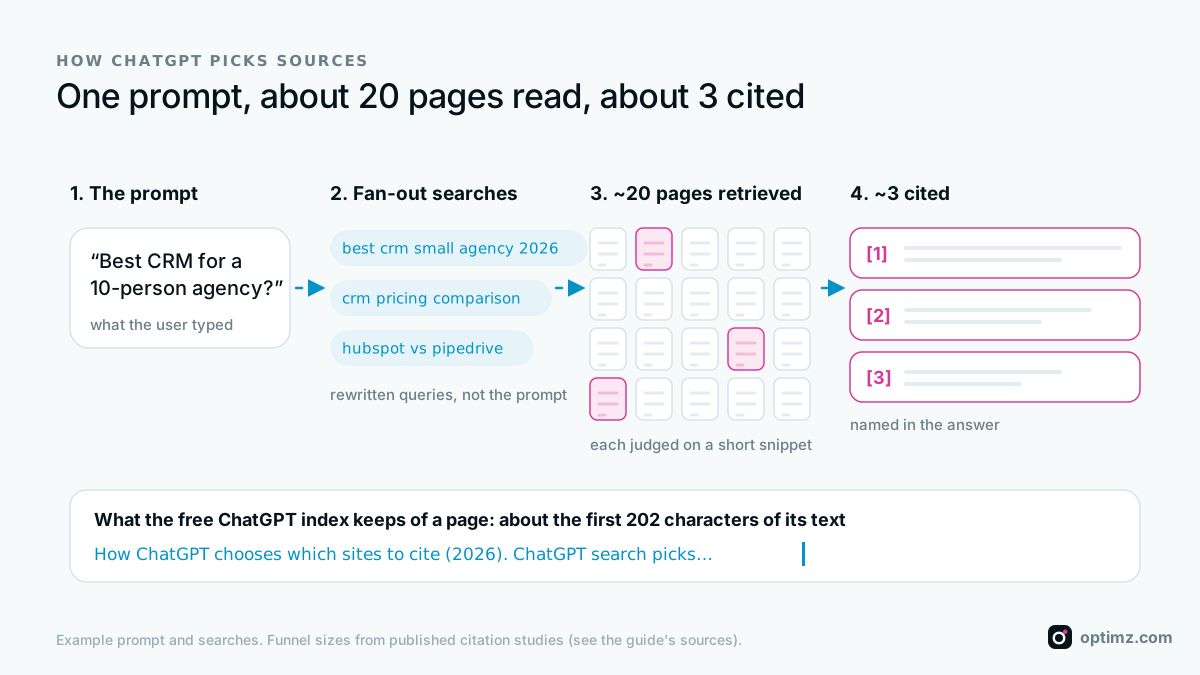
ChatGPT citations do not all come from that answer's search results. In instant mode, 85% of citations pointed to URLs absent from the answer's retrieval, coming from widgets or model memory, compared with 31% in thinking mode. About a third of attached URLs were not the lead source for the sentence they sat on. These are strong measurements, but they describe one study in one month.
Ranking in Google for the user's question predicts little. Ahrefs (Jul 2025, 15,000 prompts) found that 8% of ChatGPT's in-text citations overlapped Google's top 10, and 8.1% overlapped Bing's. Overlap by domain was about 3 times overlap by URL (31.8% vs 10%). CiteLens (Jul 2026) reported 30% overlap instead, and the disagreement is unresolved. Ranking somewhere for the rewritten queries matters more than ranking first for the head term.
Freshness: ChatGPT cites newer pages than Google ranks
ChatGPT tends to cite newer pages than Google's organic results show. Ahrefs' freshness study (17 million URLs) found AI assistants cite pages 25.7% newer than organic results, with ChatGPT the freshest of the engines measured, about 393–458 days newer. A lab study of LLM reranking (Fang et al., SIGIR-AP 2025) found that adding a recent date alone moved a passage up by as many as 95 ranks. Together these make freshness a strong factor for ChatGPT, though the size of the effect differs by engine.
Two details narrow the advice. RESONEO (Feb 2026) saw per-query recency filters of 7, 30 and 365 days in thinking mode, a plausible single observation. Adding words like “today” to a prompt did not change how the engine searched. Faking a date is a spam risk, and Google warns against changing dates without changing content. Update a page when its facts change, and show a visible updated date that matches.
How “site:” queries make a brand's official pages matter
ChatGPT increasingly searches brand websites directly with the “site:” operator, so a brand's own pages need to state its facts. RESONEO found the share of fan-out queries using “site:” rose from 3.5% in free instant mode to 58% in high-effort thinking. Ahrefs (Oct 2026) found 76% of “site:” queries went to brand sites. Both are strong measurements of the same trend: for official facts, ChatGPT goes to the source.
If pricing, specifications, locations or policies live only in PDFs, images or third-party listings, a “site:” search on the brand's domain comes back thin. Practical steps:
- Publish pricing, plans and specifications as text on crawlable pages.
- Give each important official fact a page whose H1 and first sentence state it.
- Use the words fan-out queries use, such as “official”, “pricing”, “2026” and “vs”.
- Link new pages from existing ones. In a single RESONEO test, GPTBot followed none of 8 sitemap-only URLs but all 8 linked URLs.
What doesn't matter for ChatGPT citations: meta descriptions and JSON-LD
Meta descriptions and JSON-LD structured data do not reach ChatGPT's retrieval in the tests available. RESONEO found the stored snippet comes from the rendered body, not the meta description, and that JSON-LD is stripped when ChatGPT reads a page. Independent fetch tests by searchVIU and Pilot Digital found the same: none of the JSON-LD they tested reached the models, in 8 and 15 tests.
The best controlled evidence points the same way. Ahrefs' difference-in-differences study (May 2026) compared 1,885 pages that added JSON-LD with about 4,000 matched controls and found a +2.2% change for ChatGPT that was not statistically significant. Schema is still useful for Google rich results. As a lever for AI citations, it is refuted.
Other common tactics help less than claimed, or not at all:
- llms.txt: Ahrefs found that 97% of the files on 137,000 sites were never fetched.
- Bolted-on statistics and quotations: a 2026 re-run of the original GEO tactics on modern engines found effects indistinguishable from zero, or negative.
- Content that needs JavaScript: ChatGPT's fetcher does not run it, though it reads noscript content and CSS-hidden text.
- Very heavy pages: RESONEO reported that pages over 4 MB were rejected.
ChatGPT app vs API: why tracking results differ
The ChatGPT app and OpenAI's API with web search do not return the same sources, so API-based tracking is a proxy for the app. In a 62-prompt test, RESONEO found the API model searched again in 61–71% of answers, compared with 0–17% in the app, and used “site:” and opened pages more often. An academic comparison (arXiv 2610.15382) found the API's full source list covered only 22.9% (GPT-5.3) and 22.5% (GPT-5.5) of the pages the app cited. Both results are strong.
The OpenAI API also exposes things the app hides. OpenAI's documentation lists the full consulted source list, citations with character offsets, a user location setting, and “usually (but not always)” the search queries. That makes the API good for seeing mechanisms and trends, and weaker for claiming exactly what an app user saw. Label the two separately and never mix them silently.
Optimz's AI visibility tracking asks each tracked question through the engines' APIs with web search on, and can add a weekly check of the ChatGPT app itself.
Checklist: how to get a page cited by ChatGPT
A page gets cited by ChatGPT when OAI-SearchBot can reach it, its opening answers a rewritten query, and the brand's own site holds the official facts. Work through these steps in order. The first three are gates.
- Allow OAI-SearchBot and ChatGPT-User in robots.txt and in firewall or CDN bot rules. Blocking GPTBot is a separate, training-only decision. The AI crawler user-agent list has the exact names.
- Put the main content in the server HTML, not only in JavaScript.
- Check that important pages are indexed in Bing, which still feeds parts of ChatGPT.
- Start the body with the H1, then one sentence that answers the question. Move kickers, dates, breadcrumbs and hero images out of the first 202 characters.
- Write headings and openings in the language of fan-out queries: the year, “official”, “pricing”, “vs”, “best”.
- Publish official facts such as prices, plans, specs and policies as text on the brand's own pages.
- Update time-sensitive pages when their facts change, with a visible date that matches.
- Link new pages internally instead of relying on the sitemap.
- Skip meta descriptions, JSON-LD and llms.txt as ChatGPT citation tactics.
- Measure with repeated samples, and keep API and app data apart.
Sources
- OpenAI, Overview of OpenAI crawlers
- OpenAI, Web search tool (API documentation)
- RESONEO, How ChatGPT retrieves and cites sources (Jul 2026)
- Ahrefs, Query fan-out in ChatGPT (Oct 2026)
- Ahrefs, AI search citation overlap with Google and Bing
- Ahrefs, Do AI assistants prefer to cite fresh content?
- Ahrefs, Schema markup and AI citations (May 2026)
- Profound, Where ChatGPT's citations come from
- cloro, How often ChatGPT grounds answers in search
- arXiv 2610.15382, ChatGPT web app vs API web search
- Growth Memo, Where on the page ChatGPT citations come from
- searchVIU, What ChatGPT, Claude, Perplexity and Gemini see of schema markup