Three acronyms now describe overlapping work, and vendors often sell the gap between them as bigger than it is. This guide covers what the terms mean, where they came from, what carries over from SEO and what is new. AI engines change monthly, so treat every number as a dated snapshot.
GEO vs AEO vs LLM SEO: one job with several names
GEO (generative engine optimization) and AEO (answer engine optimization) describe the same work: getting a brand named, recommended and cited in answers written by AI systems. The engines are the same for both: ChatGPT, Gemini, Claude, Perplexity, Copilot, and Google's AI Overviews and AI Mode.
You will also see LLMO (large language model optimization), LLM SEO, AI SEO and AIO. None of them has a fixed definition. A 2026 survey of 45 GEO studies found that the field's “terminology, metrics, and evidence standards remain heterogeneous” (Martinez, arXiv). AIO is the most confusing of the set, because many SEOs use the same letters for Google's AI Overviews.
Pick one term with each client, define it in a sentence, and move on: the work doesn't change with the label. The glossary entries for GEO and AEO give short definitions.
Where the terms came from: answer boxes, then the 2023 GEO paper
AEO is the older term, from the era of answer boxes and voice assistants. GEO comes from one research paper, first posted to arXiv in November 2023.
Before chatbots, an answer engine meant a search engine that answered the question itself instead of only listing links. Google's featured snippets were the main example: a box at the top of the results holding a passage from one page. In January 2018, Google described that box and its spoken version, which Google Home reads aloud and credits to the source page. AEO grew up around winning that box and those voice answers, and the label stretched to cover AI answers when they arrived.
GEO has a precise origin. “GEO: Generative Engine Optimization”, by Pranjal Aggarwal, Vishvak Murahari, Tanmay Rajpurohit, Ashwin Kalyan, Karthik Narasimhan and Ameet Deshpande, with authors at Princeton University and IIT Delhi, was first posted on 16 November 2023 and published at KDD 2024. It built GEO-bench, a set of 10,000 queries, and tested edits to source pages such as adding quotations, statistics and citations. The abstract reports visibility gains of up to 40%, and the paper reports up to 37% in a test on Perplexity. The name stuck. The tactics, as the section on lab tactics below shows, have not held up.
SEO vs AEO vs GEO compared: a side-by-side table
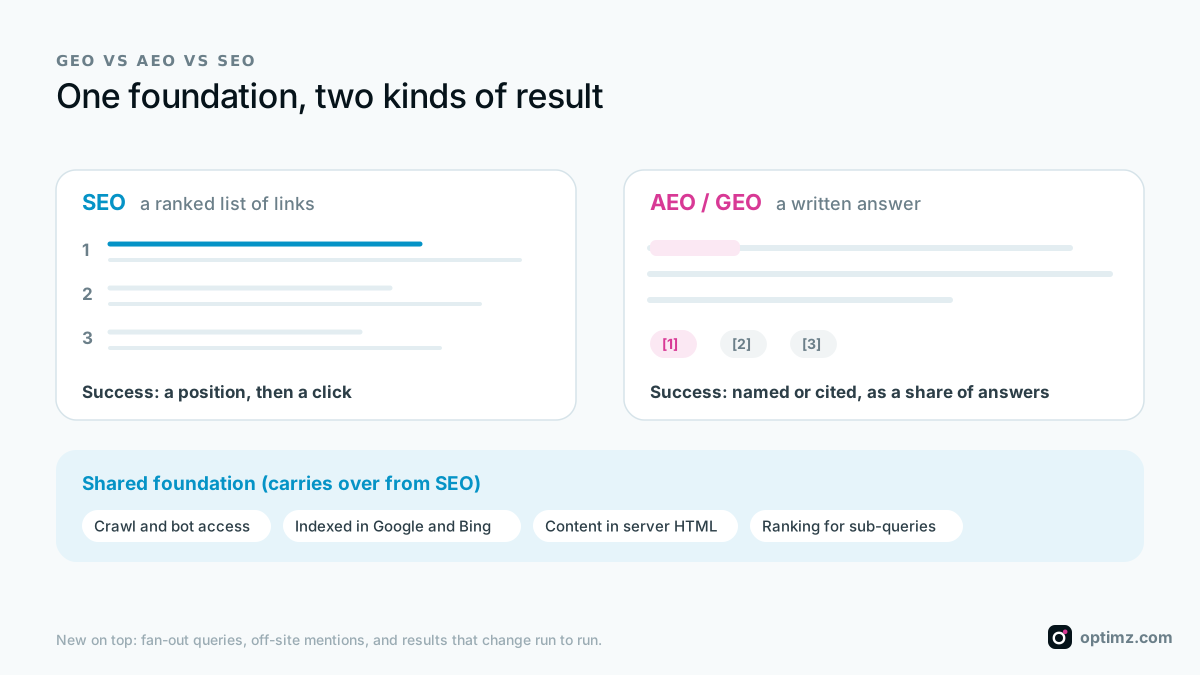
SEO wins a position in a ranked list of links. AEO and GEO win a mention or a citation inside generated text, measured as a rate across many runs. The table sets the two side by side.
| Dimension | SEO | AEO and GEO |
|---|---|---|
| Unit of success | A ranking position for a keyword, and the click that follows | Being named, recommended or cited in an answer, counted as a share of many answers |
| Surface | Ranked lists of links in Google and Bing | Written answers in ChatGPT, Gemini, Claude, Perplexity, Copilot, AI Overviews and AI Mode |
| What's measured | Positions, impressions, clicks and click-through rate | Mention rate, recommendation rate, citation coverage and share of voice, each with a range |
| How deterministic | Fairly stable for a given query, place and device | Low: the same brand list came back in under 1% of 2,961 runs (SparkToro, Jan 2026) |
| Main levers | Crawl and index access, relevance, links, page experience | The same gates, plus ranking for fan-out sub-queries, a quotable opening and off-site mentions |
| Time to effect | Waits for recrawl and reranking | Retrieval waits for each engine's own recrawl; trained knowledge waits for a new model; reading a change takes 2–4 weeks of samples |
| Tools | Search Console, Bing Webmaster Tools, rank trackers, site crawlers | Answer-sampling trackers, Bing's AI Performance report, engine APIs that return their searches, server logs |
Two rows need a note. Google's Search Console counts traffic from AI Overviews and AI Mode inside the ordinary “Web” search type, so Google's own tool can't separate AI visibility from classic rankings. And the 2–4 weeks comes from measurement research, which found that estimates settle only after weeks of repeated runs and recommends rolling windows of that length (Don't Measure Once, arXiv, Apr 2026).
What carries over from SEO to GEO and AEO
Most of the plumbing carries over. AI engines search an index before they answer, so indexing, crawl access and ranking still decide whether a page is in the running. Google says plainly that “the best practices for SEO remain relevant” for its AI features.
- Indexing and snippet eligibility. To appear in AI Overviews or AI Mode, a page must be indexed and eligible to show with a snippet. Google says there are “no additional requirements”, and no special schema.org markup or AI text files to add.
- Crawl access. AI companies run their own search bots, such as OAI-SearchBot and PerplexityBot, and robots.txt or a firewall rule can lock them out just as it can lock out Googlebot. The AI crawler user-agent list names each one.
- The indexes behind the engines. Gemini, AI Overviews and AI Mode use Google's index. Microsoft documents that Copilot Chat grounds answers through the Bing search service. Perplexity runs its own index of more than 200 billion URLs. ChatGPT mixes sources: in RESONEO's July 2026 data, free instant answers drew 63.6% of results from OpenAI's own index, while paid thinking answers drew 74.6% from scraped Google results.
- Ranking, for the right queries. Surfer found a Spearman correlation of 0.77 between the number of fan-out sub-queries a page ranks for and how often AI Overviews cite it (10,000 keywords, correlational). In the C-SEO Bench lab study, moving a document higher in the model's context, the nearest thing to better ranking, was “significantly more effective” than rewriting it.
So GEO doesn't replace SEO. A page that isn't indexed, can't be fetched or ranks nowhere for the sub-queries is invisible to both. The Optimz site audit checks crawler access, server-rendered content, an answer at the top of the page, and indexing in Google and Bing, because those gates come before anything AI-specific. Per-engine detail is in how Google AI Overviews and AI Mode pick sources and how ChatGPT chooses which sites to cite.
What's genuinely new in generative engine optimization
Four things are new: engines search with their own rewritten queries, choose passages rather than pages, also answer from trained memory, and vary from one run to the next.
Fan-out queries replace the keyword
AI engines rarely search with the words the user typed. An academic comparison found that GPT-5.3 and GPT-5.5 Instant never searched with the user's exact wording (arXiv 2610.15382, 2026). Google says AI Mode breaks a question into subtopics and issues “a multitude of queries simultaneously”. Microsoft says Copilot Chat sends Bing a query of “a few words” built from the prompt. In Ahrefs' study of 66.6 million logged-out ChatGPT responses (Oct 2026), words like “official”, “2026” and “price” were becoming more common in those rewrites.
That is why ranking for the head term predicts little. Only 8% of ChatGPT's in-text citations overlapped Google's top 10 for the prompt (Ahrefs, 15,000 prompts, Jul 2025), and 38% of pages cited in AI Overviews ranked in the top 10 for the query (Ahrefs, Mar 2026). Keyword research becomes fan-out research: collect the searches engines actually run, then build pages that answer them. The Optimz fan-out queries view keeps the web searches each AI engine ran while answering, so you can see what it looked for, not just what it said.
Snippet-level selection instead of page ranking
Engines mostly judge a passage, not a page. For most free ChatGPT retrievals, the model sees only the first ~202 characters of a page's rendered body text, and 77% of those snippets started with the H1 (RESONEO, 2026). Perplexity says it splits documents into “self-contained spans”, each retrieved and ranked on its own. And far more is retrieved than cited: in RESONEO's July 2026 data, the median ChatGPT answer listed about 20 pages and cited 3.
In SEO a weak first paragraph costs a little. In AI search it can be the whole pitch. Put the direct answer under the H1, and write sections that still make sense when lifted out alone. The snippet window entry explains the 202-character limit.
Trained knowledge and off-site mentions
When an engine doesn't search, it answers from what the model learned in training. ChatGPT searches in roughly 14–18% of answers overall (Profound, 700,000 conversations; Ahrefs, 66.6 million responses), though a smaller study found search on more than 80% of commercial prompts (cloro). What a model knows about an entity rises with the number of training documents that mention it (Kandpal et al., ICML 2023), and that knowledge freezes at each release. A model's effective cutoff is often earlier than its stated one (Cheng et al., COLM 2024), so off-site work can take a model generation or more to show up.
Off-site mentions matter when engines search, too. Across 75,000 brands, branded web mentions correlated with AI brand visibility at Spearman 0.66–0.71, and YouTube mentions at about 0.74 (Ahrefs). That is a correlation, and brand size confounds it. In a separate study, AI search tools showed a strong preference for earned media over brand-owned and social content, while Google's results drew on a more even mix (Chen et al., arXiv 2025). SEO always valued links. GEO also values being discussed in the places engines read. The guide to known vs found shows how to tell which problem a brand has.
Sampling noise: one question, many different answers
A search ranking is broadly repeatable. An AI answer is not. In SparkToro's test of 2,961 runs, the same list of brands came back less than 1% of the time, and in the same order about 0.1% of the time (Jan 2026). Ahrefs asked the same questions daily for 20 days and found that only 4.0–6.8% of citations on AI Overviews, AI Mode and ChatGPT lasted the whole period (Oct 2026).
The defensible unit is a rate over many runs, with a range. At a 50% mention rate, a margin of ±5 points needs about 400 answers (Peec AI, standard binomial math). A screenshot of one answer proves nothing either way. The method is set out in how to measure AI visibility without fooling yourself.
Why lab GEO tactics don't transfer to production AI engines
The original GEO tactics were tested on pages already placed in front of the model. Production engines have to find the page first, and replications on modern engines found the edits don't help.
In the 2023 setup, the engine was gpt-3.5-turbo given the top five Google results for each query, so every edited page was guaranteed a place in the model's context. The 2026 survey of 45 studies notes that the paper's gains are “conditional on a source already being present in a fixed context”, and concludes that “no reviewed technique shows a stable, longitudinal, cross-platform causal effect” (Martinez, arXiv).
- C-SEO Bench (NeurIPS 2025) found most conversational SEO methods “largely ineffective”, and many hurt: 26 of 30 cases were significantly negative for product recommendations on Claude 3.5 Haiku. Gains also shrank as more documents used the same method, which the authors describe as “congested and zero-sum”.
- A September 2026 preprint re-measured the original levers on ten modern engine families and found they moved citations on none of them. Its authors are linked to a vendor, but the result agrees with C-SEO Bench.
- Keyword stuffing scored below the unedited baseline even in the original paper.
What does hold up is less exotic. In 252,000 paired trials across six models, topical relevance was the largest driver of citation and explicit prices were a consistent gain, while formatting-only edits did little (What Gets Cited, arXiv 2026). Use real statistics and quotations where they help a reader, not as a citation tactic. Each factor is graded by evidence in what moves AI citations.
How to staff and budget GEO alongside SEO
Treat GEO as an extension of the SEO team, not a separate department. The work splits into three jobs, and only one of them is new.
- Technical and retrieval work stays with SEO: crawl access, indexing in Google and Bing, server-rendered content, and pages that answer the fan-out sub-queries. This is most of the early effort, and it serves both channels.
- Off-site work goes to PR: earned mentions, reviews and comparisons in the sources engines cite for your questions. It is slow, and AI search asks for more of it than classic SEO did.
- Measurement is the new job. It needs someone comfortable with samples and ranges, because rank tracking doesn't cover it and Search Console can't separate AI traffic.
Budget measurement by answer count, not keyword count. Answers per week are questions × engines × runs. Tracking 30 buyer questions on 4 engines with 5 runs each is 600 answers a week, or 2,400 over four weeks. That reads a client's pooled rate to within about ±2 points, but each question gets only 80 answers, about ±11 points, so judge the portfolio before any single question. Bing's AI Performance report, in public preview since February 2026, adds first-party data on citations in Copilot and Bing's AI answers, the pages cited and the grounding queries the AI used, as a sample.
Set expectations the way you would for SEO: no one controls what an engine says. Promise better inputs and honest measurement, not a mention or a position. What agencies should measure for SEO and AI visibility lists the metrics to keep side by side rather than blended into one score. Optimz AI visibility tracking asks AI engines your clients' buyer questions every week and reports how often each client is mentioned, recommended and cited, with a 95% range.
GEO vs SEO decision checklist
Fix what SEO and AI search share first, then add the AI-specific work, then measure it properly. Work through the list in order.
- Are your key pages indexed in Google and Bing and eligible for snippets? If not, start there: it is SEO work, and it blocks everything else.
- Can search and AI retrieval bots fetch the pages, with the main content in the server HTML?
- Do you know which fan-out searches engines run for your buyer questions? Collect them before writing anything new.
- Does each important page give its answer under the H1, in the first ~200 characters?
- Is the brand missing even when engines don't search? That is a trained-knowledge gap: plan off-site work on a long horizon.
- Are you reporting rates over many runs with ranges, kept apart from rankings, instead of screenshots?
- Are you still spending on special schema, AI text files or bolted-on statistics as AI tactics? Move that effort to retrieval and off-site work.
- Do retrieval, off-site work and measurement each have a named owner?
Sources
- Aggarwal et al., GEO: Generative Engine Optimization (arXiv 2311.09735, KDD 2024)
- Google Search Central, AI features and your website
- Google, AI Mode update from I/O 2025
- Google, A reintroduction to Google's featured snippets (Jan 2018)
- Microsoft Learn, Copilot Chat privacy and protections (Bing web grounding)
- Bing Webmaster Blog, Introducing AI Performance in Bing Webmaster Tools (Feb 2026)
- Perplexity, Architecting and evaluating an AI-first search API (Sep 2025)
- Martinez, a critical survey of generative engine optimization (arXiv, Jul 2026)
- Puerto et al., C-SEO Bench (NeurIPS 2025)
- GEO re-run and content-score validation (arXiv, Sep 2026)
- What Gets Cited: paired trials across six LLMs (arXiv 2026)
- ChatGPT web app vs API citations (arXiv 2610.15382, Oct 2026)
- Kandpal et al., LLMs struggle to learn long-tail knowledge (ICML 2023)
- Cheng et al., Dated Data: effective knowledge cutoffs (COLM 2024)
- Chen et al., Generative Engine Optimization: How to Dominate AI Search (arXiv 2025)
- Schulte, Bleeker and Kaufmann, Don't Measure Once (arXiv, Apr 2026)
- RESONEO, How ChatGPT retrieves and cites sources (Jul 2026)
- Ahrefs, Query fan-out in ChatGPT (Oct 2026)
- Ahrefs, AI search citation overlap with Google and Bing
- Ahrefs, AI Overview citations and the top 10 (Mar 2026)
- Surfer, query fan-out and AI Overview citations
- Ahrefs, AI brand visibility correlations (75k brands)
- SparkToro, AIs are highly inconsistent when recommending brands (Jan 2026)
- Ahrefs, How stable are AI citations? (Oct 2026)
- Peec AI, the key to prompt tracking: sample sizes (Sep 2026)
- Profound, Where ChatGPT's citations come from
- cloro, How often ChatGPT grounds answers in search