Ranking in ChatGPT means being named, recommended or cited more often across many answers to your buyers' questions. It is not a fixed slot. In a SparkToro test of 2,961 runs (Jan 2026), ChatGPT, Claude and Google's AI returned the same list of brands less than once in 100 runs, and the same list in the same order less than once in 1,000.
Nobody can promise you a place in ChatGPT's answers. You can raise the odds and measure them honestly. This guide is that plan, in nine steps, with the evidence behind each.
Trained knowledge vs search: why some chats never search
ChatGPT names a brand either from what the model learned in training or from pages it finds when it searches, and the question decides which. In cloro's August 2026 test (634 responses), ChatGPT searched on 86.5% of commercial prompts and 0.9% of informational ones. A 45-day study of four engines found 57.8% of ChatGPT runs had no citations at all (Don't Measure Once, arXiv 2026).
Without search, the answer comes from parametric knowledge. Models answer more accurately about things that appear in more training documents (Kandpal et al., ICML 2023), and that knowledge is fixed at training. A model's effective cutoff often differs from the date its maker reports (Cheng et al., 2024).
That sets the timing of this plan. Page changes and new mentions elsewhere can reach search-based answers once they are crawled. They reach trained knowledge only when a newer model is trained on them and released, so off-site work pays off over months, not days. The free does AI know my brand check shows what models know with search off, and why a brand is missing from ChatGPT: known vs found explains how to read it.
How ChatGPT picks sources, in brief
When ChatGPT searches, it rewrites the question, pulls about 20 results and cites a few. RESONEO's capture of 1,249 answers (Jul 2026) found:
- Free instant answers took 63.6% of results from OpenAI's own index and 34.7% from scraped Google. Paid thinking took 74.6% from Google.
- From OpenAI's index, ChatGPT saw about the first 202 characters of a page's body text, not the meta description.
- A median answer listed about 20 pages, promoted 5 and cited 3.
OpenAI removed the field that labelled these providers on July 21, 2026, so treat the split as a dated snapshot. The full mechanics are in how ChatGPT chooses which sites to cite.
The plan at a glance: nine steps to get recommended by ChatGPT
The steps run in order: measure, clear the gates, improve your pages, earn mentions elsewhere, measure again. Effort is a rough estimate for one brand. The grade is the strength of the evidence behind each step.
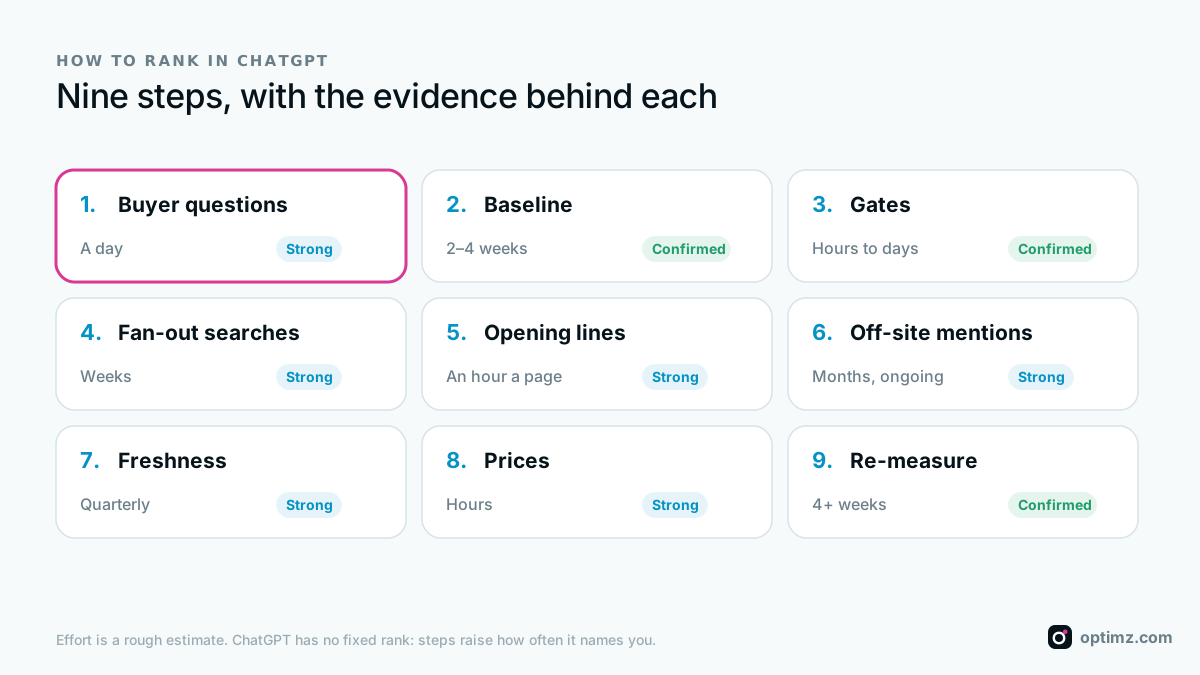
| Step | What to do | Rough effort | Evidence grade |
|---|---|---|---|
| 1. Buyer questions | 15–30 real questions, each written 3–5 ways | A day | Strong (measurement studies) |
| 2. Baseline | Many runs per question group over 2–4 weeks | 2–4 weeks, mostly waiting | Confirmed |
| 3. Gates | OAI-SearchBot access, server HTML, internal links, Bing | Hours to days | Confirmed |
| 4. Fan-out searches | Pages for the rewrites: year, price, vs, official | Weeks | Strong |
| 5. Opening lines | H1, then a direct answer, on key pages | An hour per page | Strong |
| 6. Off-site mentions | Lists, reviews, communities, comparisons | Months, ongoing | Strong (correlation) |
| 7. Freshness | Real updates with a visible date | Quarterly | Strong |
| 8. Prices | Real prices in the text of commercial pages | Hours | Strong (lab) |
| 9. Re-measure | Same questions, a control group, enough runs | 4 weeks or more | Confirmed |
Step 1: Pick 15–30 real buyer questions and group the paraphrases
Start with 15 to 30 questions real buyers ask before choosing a business like yours, each written three to five ways. That pools into a stable rate and stays small enough to review by hand.
- Take wording from sales calls, support tickets, site search and Search Console, not only a keyword tool.
- Split branded questions (“is Acme good for small teams?”) from non-branded ones (“best payroll software for 20 staff”). Peec AI advises never mixing them in one number, and says non-branded questions are where changes have the most impact.
- Cover the decision: “best X for Y”, “X vs Y”, “X pricing”, “alternatives to X” and “how do I…”.
- Ask in your buyers' language and country, and keep the set fixed.
Wording matters more than you'd expect. A May 2026 paper on OpenAI's and Anthropic's APIs (arXiv 2605.27440) found recommended brands overlapped only 0.29 (Jaccard) across cosmetic rewordings, against 0.50 to 0.61 when the same wording was re-asked. One wording measures that wording; a paraphrase group measures the intent.
Step 2: Measure a baseline over many runs, not one screenshot
Your baseline is the share of answers that mention, recommend or cite you, pooled over many runs of each question group across two to four weeks. A screenshot shows what happened once.
The arithmetic is unforgiving. Pinning a 50% rate to within ±10 points takes about 100 answers, and ±5 points almost 400 (Peec AI, Sep 2026). Don't Measure Once recommends at least 7 runs per prompt per day and a two- to four-week rolling window; its error on a brand's rate fell below 0.05 only after about 24 days.
- Mention rate: the share of answers that name you.
- Recommendation rate: the share that put you forward as an option.
- Citation rate: the share that link to your pages.
Keep the three apart, and save the pages ChatGPT cites when it names competitors: that is your target list for Step 6. Optimz AI visibility tracking reports the three rates with a 95% range. Running it by hand? How to measure AI visibility without fooling yourself covers the statistics.
Step 3: Pass the gates: OpenAI's crawlers, server HTML and Bing
Before any content work, make sure ChatGPT can reach and read your pages. These checks are pass or fail, and one failure cancels the rest of the plan.
- Allow OAI-SearchBot. OpenAI's crawler documentation says opted-out sites “will not be shown in ChatGPT search answers”, and a robots.txt change can take about 24 hours to apply.
- Let ChatGPT-User through. It fetches pages for user requests; OpenAI says robots.txt “may not apply” to it, but firewall and CDN bot rules can still block it.
- Decide on GPTBot separately. Disallowing it tells OpenAI not to train on your content. It is a training decision, not a search one.
- Check firewall and CDN bot settings. A challenge page stops a crawler as surely as robots.txt.
- Put the main content in the server HTML. In a test reported by Advanced Web Ranking (Aug 2026), ChatGPT did not run a page's JavaScript and reported a decoy value from the raw HTML.
- Link new pages from existing ones. In a RESONEO test, GPTBot followed none of 8 sitemap-only URLs but all 8 linked ones.
Older advice says ChatGPT runs on Bing. RESONEO never observed Bing as a source on any account it tested in mid-2026, though another analyst saw a Bing pipeline behind 93.7% of sources on a ChatGPT Team account in June. Keep key pages indexed in Bing and send changes through IndexNow as cheap insurance, but on free ChatGPT, OpenAI's own index matters more.
The free AI crawler checker tests robots.txt for each OpenAI bot, firewall challenges and whether your text is in the server HTML.
Step 4: Win the fan-out searches behind each question
ChatGPT doesn't search for your buyer's exact words. It searches for rewrites, called fan-out queries, and your pages have to match them.
Ahrefs studied 66.6 million ChatGPT responses (Oct 2026); 14.4% contained fan-out searches. In September:
- “2026” appeared in 22.9% of fan-out queries, up from 17.6% in August.
- “official” appeared in 13.1%, “price” in 8.9% and “reviews” in 3.6%.
- 6.8% used “site:” to search inside one website. Among the most-searched sites, about three in four were brands' own.
Turn that vocabulary into pages. For each question group, check you have:
- A pricing page with the current year and real numbers in the text.
- Honest “X vs Y” pages for your main competitors, including where they suit a buyer better.
- A “best X for Y” page built around the buyer's need, with real alternatives named.
- Official facts pages for plans, specifications, locations and policies, each with an H1 that states the fact.
Official pages count even on comparison questions: in the same data, 68.3% of comparison answers cited at least one official source, against 84.4% for factual ones. Optimz fan-out queries show the searches each engine ran for your tracked questions, so you write for real rewrites instead of guesses.
Step 5: Make the opening 200 characters a quotable answer
On key pages, start the body with the H1 and follow it at once with one sentence that answers the question. For results from OpenAI's index, that opening is most of what ChatGPT sees.
RESONEO's fingerprinted test pages showed the stored snippet is about the first 202 characters of the rendered body, and the meta description is ignored. Of 387 snippets containing the H1, 297 (77%) started with it. Anything above the H1 uses up the budget: breadcrumbs, labels, dates, reading times, hero-image alt text. The snippet is also frozen at crawl time; 13% ran more than a month behind, so a new opening reaches ChatGPT only after a recrawl.
Check any page with the free ChatGPT snippet preview, which shows the opening ChatGPT would keep and anything before the H1.
Step 6: Earn mentions on the sites ChatGPT already cites
Mentions of your brand on other sites are the strongest measured factor in whether AI assistants name you. The work happens away from your site, and it is slow.
Ahrefs compared 75,000 brands (Dec 2025). Branded web mentions correlated with ChatGPT brand visibility at 0.664, and YouTube mentions at about 0.737 across the AI surfaces studied, while Domain Rating reached 0.266 for ChatGPT. Ahrefs notes that correlation isn't causation, and big brands have more of everything.
Lists weigh most on recommendation questions. In Ahrefs' study of 750 prompts (Dec 2025), “best X” blog lists were 43.8% of the page types ChatGPT cited, and 79.1% of the 1,100 lists used as sources had been updated in 2025. Where to work:
- Lists and roundups. Start with pages ChatGPT cited for competitors in your baseline. Send authors facts they can check: what you do, who it suits, prices, what changed.
- Reviews. Ask real customers for reviews on the platforms your buyers read. Never buy or write them.
- Communities. Answer questions where your buyers ask them, with your affiliation disclosed.
- Comparisons and video. Third-party comparisons, YouTube reviews and tutorials put your name next to your category.
Publishing your own list helps less than you'd hope. In Ahrefs' experiment (Feb–May 2026, 9,886 answers), its self-promotional pages drove 82% of new mentions for a new, unknown event but only 6% for an established product, whose new mentions came 94% from third-party content. Citations came and went: between its first and last citation, a page was cited on about one in three eligible days.
Step 7: Keep key pages fresh with real, dated updates
Update time-sensitive pages when their facts change, and show a visible updated date that matches. ChatGPT tends to cite newer pages than Google ranks.
Ahrefs' analysis of 17 million citations (Jul 2025) found AI assistants cite content 25.7% fresher than Google's organic results, with ChatGPT's citations about 393 to 458 days newer. In a lab study of LLM reranking, adding a recent date alone moved passages by as many as 95 ranks (Fang et al., 2025).
Two cautions. Google asks site owners, “Are you changing the date of pages to make them seem fresh when the content has not substantially changed?”, so a new date needs new substance. And put the date after the opening answer, not above the H1, or it eats the 202 characters from Step 5. Review pricing, comparison and “best” pages quarterly, and pages with a year in the title each January.
Step 8: Show real prices on commercial pages
If buyers ask what something costs, put real prices in the page text. Price is one of the few on-page changes with consistent controlled evidence behind it.
In What Gets Cited (arXiv, May 2026), 252,000 paired trials across six models found explicit price information consistently raised a source's chance of being cited first, as did a recent timestamp; topical relevance and position mattered most. ChatGPT goes looking, too: “price” was in 8.9% of its fan-out queries in Ahrefs' September data.
If one fixed price isn't possible, publish a starting price, typical ranges, what drives the cost and what's included. Keep prices as text, not images or PDFs, so a “site:” search on your domain finds them.
Step 9: Re-measure with a control group and enough samples
Judge each change by comparing the questions you worked on with similar ones you left alone, over the same weeks, with enough runs. A before-and-after number alone mostly measures the platform changing.
Ahrefs' schema study (May 2026) shows why. Pages that added JSON-LD saw AI Mode citations rise 43%, but untouched control pages rose almost as much, and the net effect was +2.4%, not significant. Without controls, it would have looked like a big win.
- Keep a control group: question groups or pages you deliberately leave alone.
- Plan for more data than the baseline. Peec AI estimates confirming a change takes roughly double the runs.
- Compare four-week windows, and test the difference between rates instead of eyeballing them.
- Log model releases, since they move results for everyone at once.
What not to waste time on
Skip tactics with no measured effect on ChatGPT citations, or with a real downside:
- Schema as a ChatGPT tactic. In Ahrefs' matched study, adding JSON-LD changed ChatGPT citations by +2.2%, not statistically significant, and RESONEO found JSON-LD is stripped before a page reaches the model. Keep schema for Google rich results.
- llms.txt. Of about 38,000 sites with a valid file, 97% recorded no fetches of it in May 2026 (Ahrefs).
- Hidden instructions and prompt-injection tricks. Text hidden from people, such as white-on-white or zero-size text, is spam under Google's spam policies, which also name “attempting to manipulate generative AI responses”. Paid ChatGPT leans on Google results, so a Google penalty would likely follow you there. RESONEO found ChatGPT reads CSS-hidden text anyway, so it is hidden only from your buyers.
- Chasing a position. There isn't one: the same list in the same order came back less than once in 1,000 runs.
An example timeline for the first 90 days
In the first three months, most measurable change comes from gates, page work and better measurement. Off-site work starts then and keeps paying later. A made-up firm might schedule it like this:
- Week 1: write 20 question groups, start collecting answers, run the crawler and snippet checks. Fix any failed gate at once and note the date.
- Weeks 1–4: build the baseline. Choose the groups you will work on and set aside similar ones as controls.
- Weeks 5–8: rewrite the openings of the 10 key pages, publish a pricing page and two comparison pages, and link them internally. Touch only pages behind treated groups.
- Weeks 5–12: contact the authors of lists and reviews ChatGPT cited for competitors, ask customers for reviews, answer community questions with your affiliation disclosed.
- Weeks 9–12: compare the latest four-week window with the baseline and the controls.
- After the next model release: rerun the search-off check to see whether trained knowledge has moved.
Sources
- OpenAI, Overview of OpenAI crawlers
- Google Search Central, Spam policies for Google web search
- Google Search Central, Creating helpful, reliable, people-first content
- Bing, IndexNow
- Kandpal et al., Large language models struggle to learn long-tail knowledge (ICML 2023)
- Cheng et al., Dated Data: tracing knowledge cutoffs in large language models (2024)
- Schulte et al., Don't Measure Once: measuring visibility in AI search (arXiv, Apr 2026)
- Jack et al., Paraphrase brittleness in retrieval-augmented recommendation (arXiv, May 2026)
- Vishwakarma et al., What Gets Cited: competitive GEO in AI answer engines (arXiv, May 2026)
- Fang et al., recency bias in LLM-based reranking (arXiv, 2025)
- RESONEO, What ChatGPT pulls, what it shows, what it cites (Jul 2026)
- Ahrefs, How ChatGPT does query fan-out (Oct 2026)
- Ahrefs, Top brand visibility factors in ChatGPT, AI Mode and AI Overviews (Dec 2025)
- Ahrefs, Do self-promotional “best” lists boost ChatGPT visibility? (Dec 2025)
- Ahrefs, Self-promotional content works until it backfires (Jul 2026)
- Ahrefs, AI assistants prefer to cite fresher content (Jul 2025)
- Ahrefs, 1,885 pages adding schema: AI citations barely moved (May 2026)
- Ahrefs, 97% of llms.txt files never get read (Jun 2026)
- cloro, How often ChatGPT grounds answers in search (Aug 2026)
- SparkToro, AIs are highly inconsistent when recommending brands (Jan 2026)
- Peec AI, The key to prompt tracking (Sep 2026)
- Advanced Web Ranking, What AI search crawlers read (Aug 2026)