The four AI visibility metrics: mention, recommendation, citation, share of voice
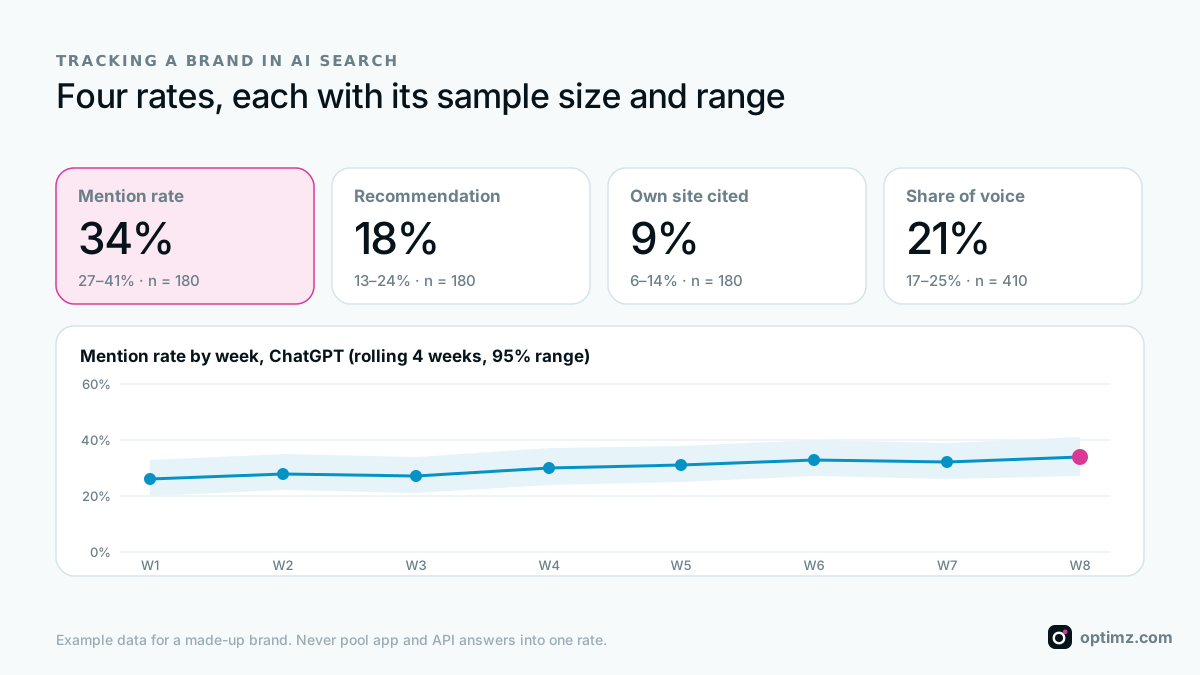
Track four rates, because each answers a different question about the same AI answers. Mention rate asks whether the engine names you. Recommendation rate asks whether it suggests you. Citation rate asks whether it links to your own site. Share of voice asks how much of the conversation you get against every other brand named.
| Metric | What it counts | Out of | Why it can disagree with the others |
|---|---|---|---|
| Mention rate | Answers that name your brand or a known alias | All usable answers | The broadest signal. A passing mention in a list of ten counts the same as top billing. |
| Recommendation rate | Answers that suggest your brand for what was asked | All usable answers | Stricter, and a judgement call on each answer. Write the rule down first. |
| Citation rate (owned citations) | Answers that link to at least one page on your own domain | All usable answers | Engines often answer without links. A review site that names you is a third-party citation, not an owned one. |
| Share of voice | Your mentions as a share of all brand mentions in the same answers | Mentions of every brand named | Moves when competitors gain or lose, even if your own rate holds still. |
Citation rate has a ceiling you don't control. In a 45-day study, 57.8% of ChatGPT runs had no citations at all (Don't Measure Once, arXiv, Apr 2026). Over 20 days, Ahrefs found no citations in 64% of Gemini answers and 53% of Copilot answers (Oct 2026). Read a low citation rate next to how often the engine cites anything.
Share of voice depends on its denominator. Count every brand the answers name, not only a hand-picked competitor list, or the number will flatter you.
Skip rank position: SparkToro saw the same brands in the same order only about once in 1,000 runs. The article on why brand mentions and citations are different metrics covers the counting rules.
How to check if ChatGPT mentions your brand: a manual method for this week
You can track your brand by hand this week with a question list, clean sessions, repeat runs and a spreadsheet. It costs only time, and it shows you what the engines actually say.
- Write 10 buyer questions, the kind customers ask before they buy: “best sourdough bakery in Leeds”, “where can I order a birthday cake in Leeds”. Mostly unbranded, where you have to earn the mention, plus a few branded ones.
- Give each question three wordings and freeze them (see paraphrase groups below).
- Use clean sessions: signed out, in a private browser window, so your own history doesn't shape the answer. That gives an unpersonalized baseline, not what every signed-in buyer sees.
- Fix the market. Ask in your buyers' language and from their country. A 2026 study of ChatGPT found the query language largely decides which country's brands appear, and the country the request comes from shifts it further (Żatuchin, arXiv, 234 runs).
- Run every wording at least once a week on each engine, on varied days.
- Log each answer as one row, using the layout below, and save the full text.
- Each week, compute the four rates per engine over the last four weeks of rows.
| Column | Example entry | Why it matters |
|---|---|---|
| Date | 2026-11-03 | The day you asked. |
| Engine and surface | ChatGPT app, signed out | Never pool apps and APIs into one rate. |
| Market | UK, English | Country and language you asked from. |
| Question group | Birthday cakes, Leeds | The buyer intent your rates roll up to. |
| Wording | B2: “who makes the best birthday cakes in Leeds” | Frozen text, with an ID. |
| Run | 1 | Which repeat, for that wording, engine and week. |
| Mentioned | Yes | Named anywhere, aliases included. |
| Recommended | No | One written rule, such as “offered as an option to choose”. |
| Own site cited | No | A link to your domain among the sources. |
| All brands named | Crumb & Co; Oven Street; Brightloaf | The right denominator for share of voice. |
| Cited domains | leedsfood.example; crumbandco.example | Which sites shape the answer instead of yours. |
| Usable | Yes | No for errors, refusals or “no AI Overview shown”. Leave those rows out of every rate. |
| Notes | New model announced 2026-11-01 | Context for sudden shifts. |
What manual AI visibility tracking can and can't tell you
Manual tracking is good for spotting large gaps and reading real answers, and too small to prove modest changes. Ten questions in three wordings, once a week on one engine, make 30 answers a week, or 120 over four weeks. At a 50% mention rate, 120 answers give a 95% range of about ±9 points, so a move from 30% to 35% is invisible.
- Getting to about ±5 points takes roughly 400 answers per engine and period, more copying and pasting than most teams keep up.
- Answers to the same question move together, so the true range is somewhat wider than the simple math suggests.
- Labelling “recommended” by hand drifts unless the rule is written down and old rows are spot-checked.
- Signed-out answers can't show what personalization does for signed-in buyers, and no outside method can.
For a quick first look, the free Does AI know your brand? check asks the models behind ChatGPT, Claude and Gemini what they know about a brand without searching the web. It asks each question once, so treat it as a starting point, not a measurement.
How many runs you need before an AI visibility number means anything
You need hundreds of answers per engine for a number you can defend, because a single answer is noise. Across independent 2026 studies, two runs of the same prompt share only about 40–60% of the brands they name. SparkToro and Gumshoe found less than a 1 in 100 chance of two answers giving the same brand list, across 2,961 runs on ChatGPT, Claude and Google's AI (Jan 2026).
- About 100 answers give a 95% range of ±10 points at a 50% rate, and about 400 give ±5 points (Peec AI, Sep 2026).
- Detecting a change takes roughly twice the runs of measuring a level (Peec AI).
- For one overall number, more questions beat more runs. On the same budget in Peec AI's example, 50 prompts run once a day gave about ±6 points on a monthly rate, and 10 prompts run five times a day about ±13.
- Don't Measure Once recommends at least 7 runs per prompt per day for brand monitoring, pooled over rolling windows of two to four weeks.
The guide to measuring AI visibility without fooling yourself works through the statistics, including Wilson ranges and when to show no number at all.
Track paraphrase groups: rewording moves results more than rerunning
Group several wordings of each buyer question and report the group's rate, because rewording moves AI answers more than asking again. In a May 2026 study of API answers, reruns of the same prompt shared 50–61% of recommended brands. Cosmetic rewrites shared 29%, and rewrites that added a constraint, such as a region, only 14% (arXiv 2605.27440, vendor authors).
One tracked prompt tells you about one string of words, not the buyers behind it. Three to five wordings per intent, frozen for the whole period, is a practical size. Vary them the way customers do: short and long, with and without a location, price or use case. The glossary defines a paraphrase group.
Automated AI brand monitoring: API data vs app data
Automated tracking collects answers through the engines' APIs or by capturing the consumer apps, and the two are different surfaces, not a noisy copy of each other. Label API data as a proxy for what people see.
- Brands: across 1,000 prompts on five AI products, API and app answers shared only 21–32% of brands after names were normalized (Surfer with cloro, Oct 2026; vendor study, single runs). ChatGPT's API named 13.8 brands per answer against 7.9 in the app, and cited 3.1 sources against 12.1.
- Pages: Google results and the API's results combined recovered only about a quarter of the pages the ChatGPT app cited (arXiv 2610.15382, Oct 2026).
- Perplexity says its API uses the same search system as the app with differences in configuration, and that the model might differ.
- Temperature zero doesn't make answers repeatable: 1,000 identical requests to one hosted model produced 80 distinct outputs (Thinking Machines, Sep 2025).
API data still has uses: it is cheap to sample often and its settings can be recorded. Store the model, settings and market with every answer, and compare it now and then with real app answers. We found no published study testing whether API trends follow app trends over time.
Optimz AI visibility tracking labels every answer with how it was collected and reports mention, recommendation and citation rates with the sample size and a 95% range.
Engine by engine: ChatGPT, Google AI, Gemini, Perplexity, Claude and Copilot
Give each engine its own rates, because the engines search differently, cite differently and give site owners different data.
| Engine | What to watch when sampling | First-party data | Analytics and logs |
|---|---|---|---|
| ChatGPT | Searches for only some prompts: 57.8% of runs in one study had no citations. | No webmaster report. | Links carry utm_source=chatgpt.com. Fetches by OAI-SearchBot and ChatGPT-User. |
| Google AI Overviews and AI Mode | Track separately: they cited the same URLs only 13.7% of the time (Ahrefs, 540k query pairs). | Search Console generative AI reports. | Clicks count as Organic Search in GA4. Crawled by Googlebot. |
| Gemini app | 64% of answers had no citations over 20 days (Ahrefs), so mention rate matters more. | None; Search Console covers Search and Discover. | gemini.google.com visits fall in GA4's AI Assistant channel. |
| Perplexity | API and app share a search system but differ in configuration. | No webmaster report. | Referrals from perplexity.ai. Fetches by PerplexityBot and Perplexity-User. |
| Claude | Slightly more likely to repeat a brand list in SparkToro's test, still far from repeatable. | No webmaster report. | Referrals from claude.ai. Fetches by Claude-SearchBot and Claude-User. |
| Microsoft Copilot | 53% of answers had no citations; 83% of citations were gone the next day (Ahrefs). | Bing Webmaster Tools AI Performance. | copilot.microsoft.com visits fall in GA4's AI Assistant channel. Crawled by Bingbot. |
Search Console and Bing Webmaster Tools AI reports
Google and Microsoft give site owners first-party AI data, and both count your pages appearing as sources, so they confirm citations, not unlinked mentions.
Search Console's Search Generative AI performance reports show how often your URLs appeared in AI Overviews and AI Mode, by page, country, device and date. Google launched them on June 3, 2026 and rolled them out to all sites by August 31, 2026. Coverage of the launch reports no clicks or queries, and one combined number for AI Overviews and AI Mode.
Bing Webmaster Tools' AI Performance report, in public preview since February 10, 2026, covers Copilot, AI summaries in Bing and select partners. It shows total citations, average cited pages, citations per page and a sample of grounding queries: the phrases the AI used to retrieve your content. A June 2026 update added intent, topic and citation share per grounding query. It shows no clicks.
AI referral traffic in analytics
Referral traffic shows the visits AI answers sent you. GA4's default channel group has an AI Assistant channel for sources such as ChatGPT, Gemini, DeepSeek, Copilot and Grok, while Google's AI Overviews and AI Mode stay in Organic Search. In other tools, filter sessions by source for chatgpt.com, perplexity.ai, gemini.google.com, copilot.microsoft.com and claude.ai.
OpenAI says ChatGPT adds utm_source=chatgpt.com to referral links, but some clicks arrive with no tag or referrer and land in Direct. In October 2026, several analytics firms saw ChatGPT sessions drop sharply for about a week after inline links lost the tag; one analyst reported that OpenAI confirmed a bug and a fix began rolling out on October 15 (Search Engine Journal). When AI referrals fall, check Direct traffic to the same pages first.
AI crawler fetches in server logs
Server or CDN logs show which pages AI bots fetched. The user-triggered fetchers, ChatGPT-User, Claude-User and Perplexity-User, are the closest log signal that an assistant read your page for a real person, though a fetch never shows the question. Check bots against the operators' published IP ranges, since user-agent strings are easy to fake. The AI crawler user-agent list has every bot name and a log search to start with.
Optimz Real AI data reads server logs, checks each AI fetch against the operator's published IP ranges, and shows the fetches next to visits referred by AI tools.
How to report AI visibility to a boss or client
Report rolling four-week rates with their sample sizes and ranges, compare them with the four weeks before, and judge any fix against a control group.
- Lead with mention rate per engine, with the number of answers and the 95% range, next to the previous four weeks.
- Show competitors from the same answers, and share of voice against every brand named.
- Add owned citation rate, Search Console AI impressions, Bing citations and AI-assistant sessions as separate lines, not one blended score.
- Mark model changes and anything you shipped on the chart.
- Call changes inside the noise “no clear change”, and link a few real answers that show the pattern.
Before/after numbers without a control mostly measure the engines changing. In Ahrefs' schema study, AI Mode citations rose 43% on pages that added schema, but matched pages that changed nothing rose almost as much, and the net effect was +2.4% and not significant (May 2026). Pick comparable questions you won't touch, and report the change in the treated ones minus the change in the control. The methodology section on control groups shows one setup.
Optimz client reports show mention, recommendation and citation rates with their ranges, competitors from the same answers, and fix results against a control group.
Checklist: what an AI visibility tracking tool should show you
Whatever you use, from a spreadsheet to any tool on the market, every number should carry enough context to judge it. Ask for these before you buy.
- The sample size next to every rate, per engine and per question group.
- A confidence range on every rate, and no number at all when the sample is too small.
- How answers were collected: API or consumer app, signed in or out, and the model where known.
- The market: country, language and, for local businesses, the city.
- The collection dates, and how many runs per question in each period.
- The exact prompts, grouped by intent, and the raw answers behind every number.
- Share of voice counted against every brand named, not only the competitors you entered.
- Failed answers and searches with no AI answer kept out of the rate and counted separately.
- Model changes marked on charts, and a way to compare treated and control questions.
- First-party data from Search Console, Bing, analytics and logs shown next to sampled data, not blended into it.
Sources
- Google Search Central, Introducing Search Generative AI performance reports in Search Console (Jun 2026)
- Microsoft Bing, Introducing AI Performance in Bing Webmaster Tools public preview (Feb 2026)
- Google Analytics Help, Default channel group
- OpenAI, Publishers and developers FAQ
- OpenAI, Overview of OpenAI crawlers
- Anthropic, Does Anthropic crawl data from the web?
- Perplexity, Perplexity crawlers
- Perplexity, API FAQ
- Schulte, Bleeker and Kaufmann, Don't Measure Once (arXiv, Apr 2026)
- Jack et al., Paraphrase brittleness in AI commercial recommendation (arXiv, May 2026)
- Jiang et al., Understanding ChatGPT citations (arXiv, Oct 2026)
- Żatuchin, query language and exit IP in AI recommendations (arXiv, Aug 2026)
- Thinking Machines, Defeating nondeterminism in LLM inference (Sep 2025)
- SparkToro, AIs are highly inconsistent when recommending brands (Jan 2026)
- Peec AI, The key to prompt tracking: sample sizes (Sep 2026)
- Ahrefs, How stable are AI citations? (Oct 2026)
- Ahrefs, AI Overviews vs AI Mode citations (Dec 2025)
- Ahrefs, Schema markup and AI citations: a difference-in-differences test (May 2026)
- Surfer, Scraped AI answers vs API results (Oct 2026)
- Search Engine Journal, ChatGPT traffic drop appears to be a tracking problem (Oct 2026)
- Search Engine Journal, Google reports AI search impressions: how to read them (Aug 2026)
- Practical Ecommerce, Bing's improved AI Performance section (Jun 2026)